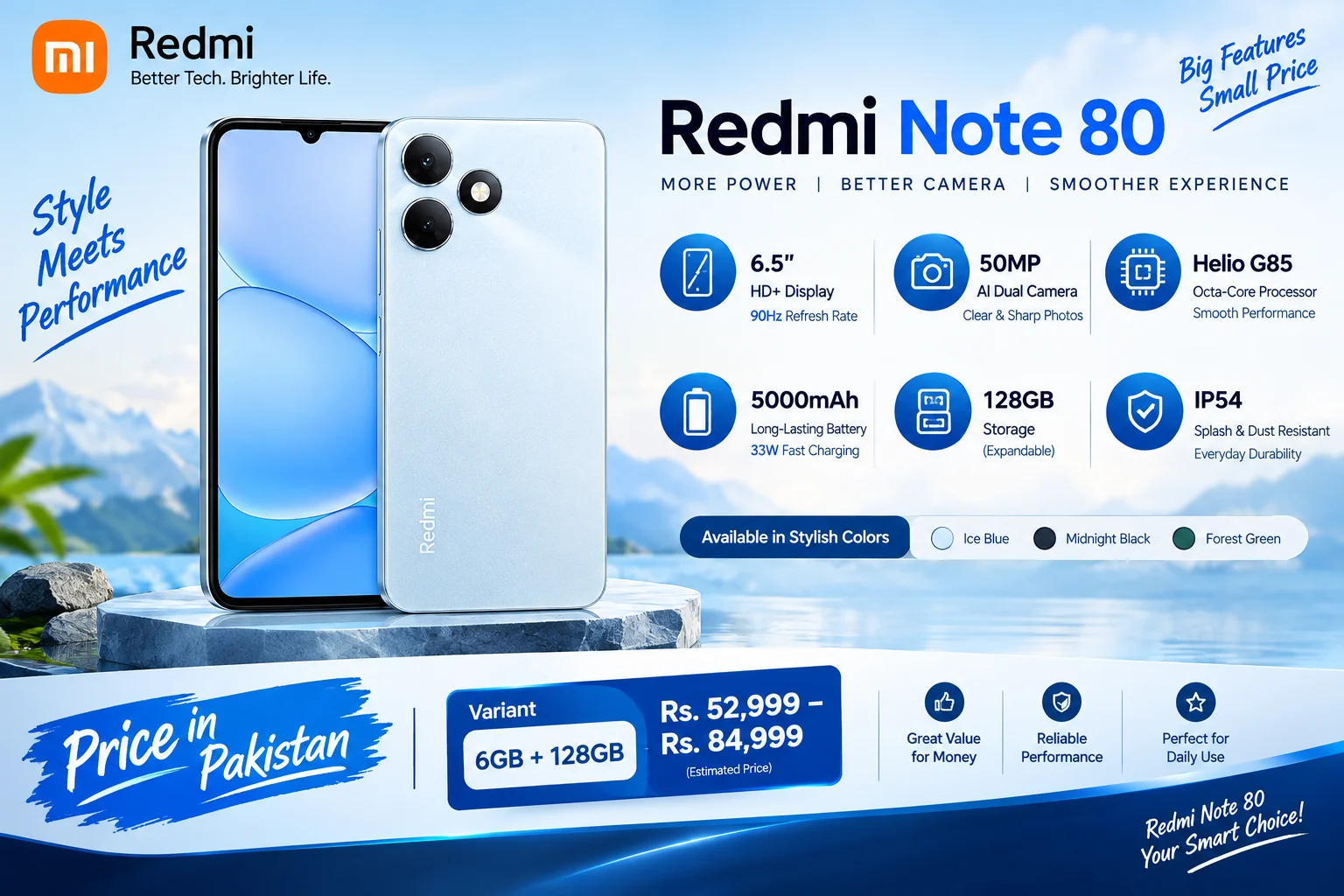

Every year, the Redmi Note series does something the rest of Pakistan’s mid-range smartphone market spends months recovering from. It arrives with a specification that resets the expectation for what a phone at this price should deliver — and then it prices that specification at a level that makes every competing brand uncomfortable.
The Redmi Note 17 Pro has done it again. But this time, the specification in question is not a camera or a display. It is a battery. A 9000 mAh battery — the largest cell ever fitted into a mainstream mid-range smartphone from Xiaomi — sitting inside a phone that also carries IP66, IP68, IP69, and IP69K quad water resistance ratings, a 6.83-inch 1.5K OLED display hitting 3500 nits peak brightness, a Snapdragon 6s Gen 4 chipset, 67W fast charging, and NFC. All of this launched officially on July 14, 2026 in China, with Pakistan availability expected in the months that follow.
Xiaomi has skipped the Redmi Note 16 name entirely — jumping straight from the Note 15 series to Note 17 to align the branding with Xiaomi’s flagship 17 lineup. That decision says something about how seriously Xiaomi is treating this generation. The Redmi Note 17 Pro is not an incremental update. It is a statement about what mid-range batteries should be, what mid-range waterproofing should look like, and what mid-range displays should achieve in 2026.
For Pakistani buyers who follow Xiaomi’s lineup, our Xiaomi Redmi 15 review and Redmi 15C review give context for where the brand has been. The Note 17 Pro represents where it is going — and it is going somewhere considerably more ambitious.
Redmi Note 17 Pro Price in Pakistan 2026
The Redmi Note 17 Pro launched in China on July 14, 2026 at the following official Chinese pricing:
8GB RAM and 128GB storage at CNY 1,599 which is approximately $235 USD
8GB RAM and 256GB storage at CNY 1,899 which is approximately $280 USD
12GB RAM and 256GB storage at CNY 2,199 which is approximately $324 USD
8GB RAM and 512GB storage at CNY 2,299 which is approximately $339 USD
Expected Pakistan Price: Rs. 74,999 to Rs. 89,999 based on Xiaomi’s historical Pakistan pricing relative to Chinese launch prices. Official Pakistan pricing will be confirmed at the local launch.
The phone is expected to arrive in Pakistan in late 2026. It comes in four color options — Sky Blue, Nebula Purple, Black, and White — through authorized Xiaomi and Redmi dealers with full official warranty coverage.
Buy Redmi Note 17 Pro: Check Latest Price and Availability on Amazon

Redmi Note 17 Pro Full Specifications
| Category | Details |
|---|---|
| OS | Android 16, HyperOS 3 |
| Chipset | Qualcomm Snapdragon 6s Gen 4 |
| CPU | Octa-Core |
| GPU | Adreno GPU |
| AnTuTu Score | 876,983 |
| Geekbench Multi-Core | 2,924 |
| Display | 6.83 inch flat OLED, 1.5K resolution |
| Resolution | 1280×2772 pixels |
| Refresh Rate | 120Hz |
| Peak Brightness | 3,500 nits |
| Minimum Brightness | 1 nit |
| Display Protection | Corning Gorilla Glass Victus 2 |
| Display Features | 12-bit color, Green Mountain eye protection |
| RAM and Storage | 8GB or 12GB LPDDR4X, 128GB or 256GB UFS 2.2 or 512GB UFS 3.1 |
| Memory Card | Not supported |
| Rear Camera | 50MP f/1.8, 1/2.76 inch sensor, PDAF + 2MP depth f/2.4 |
| Camera Video | 1080p at 30fps |
| Front Camera | 8MP |
| Battery | 9000 mAh |
| Charging | 67W wired fast charging |
| Wi-Fi | 802.11 a/b/g/n/ac Wi-Fi 5, dual-band |
| Bluetooth | v5.1 |
| NFC | Yes |
| GPS | GPS, GLONASS |
| USB | Type-C |
| Fingerprint | Under-display optical |
| Water Resistance | IP66, IP68, IP69, IP69K quad rated |
| Build | 8.46mm thickness, 226g, plastic frame, four-micro-curved side frame |
| Colors | Sky Blue, Nebula Purple, Black, White |
| Network | 5G SA/NSA, 4G VoLTE, 3G HSPA, 2G GSM |
| Price China | CNY 1,599 base variant |
| Price Pakistan | Rs. 74,999 to Rs. 89,999 expected |
Redmi Note 17 Pro Display
The display on the Redmi Note 17 Pro is one of the strongest specifications in any phone at this price point globally in 2026 — and understanding why requires looking beyond the refresh rate number that most display specifications lead with.
The 6.83-inch flat OLED panel with 1.5K resolution runs at 120Hz — standard for this tier. The number that genuinely sets this display apart from competing phones in Pakistan under Rs. 90,000 is the 3,500 nits peak brightness. At 3,500 nits, the Note 17 Pro’s display stays fully vivid and readable under direct Pakistani summer sunlight in conditions where most mid-range displays — including strong performers like the POCO X7 Pro’s 3,000 nit panel — begin to struggle. This is flagship-tier outdoor visibility delivered at a price that does not come close to flagship territory.
The 1 nit minimum brightness is equally thoughtful. Most phone displays bottom out at 2 to 5 nits in their darkest setting, which is still too bright for comfortable late-night reading or viewing in complete darkness. At 1 nit, the Note 17 Pro’s display becomes genuinely comfortable for extended late-night use — a daily benefit that health-conscious Pakistani users who spend significant evening screen time will appreciate in ways that peak brightness numbers alone do not capture.
Xiaomi’s Green Mountain eye protection system actively adjusts display parameters including color temperature, flicker rate, and brightness to reduce eye strain during extended sessions. 12-bit color depth delivers over 68 billion colors versus the 16 million colors of standard 8-bit panels — a difference that becomes perceptible in photography review, streaming, and any content with subtle color gradations.
Gorilla Glass Victus 2 on the front provides the strongest display glass available on any phone in Pakistan at this expected price range — significantly more durable against drops on rough surfaces than the Gorilla Glass 5 found on competing devices at nearby prices.

Redmi Note 17 Pro Camera
The camera system on the Redmi Note 17 Pro is functional and honest for a phone whose primary identity revolves around battery size, durability, and display quality rather than photography performance. The rear features a 50 MP main sensor with f/1.8 aperture, a 1/2.76-inch sensor size, and PDAF autofocus alongside a 2 MP depth sensor and LED flash.
The 50 MP PDAF main camera handles everyday Pakistani photography reliably — family events, outdoor shots, social media content, and casual portraits all produce consistent and satisfying results. The f/1.8 aperture gathers adequate light for indoor and evening photography, and PDAF’s speed advantage over contrast-detection autofocus means fewer missed shots in active or unpredictable shooting situations.
Video recording tops out at 1080p at 30fps the practical baseline for everyday social media and family video recording in Pakistan. This is the area where the Note 17 Pro makes its most significant camera compromise compared to competing phones at similar prices. The Infinix Note 60 Ultra 5G at Rs. 94,999 records 4K video at 60fps with OIS. The Note 17 Pro stops at 1080p — a decision that reflects Xiaomi’s choice to invest the engineering and component budget in battery chemistry and water resistance rather than camera hardware for this specific model.
For Pakistani buyers whose content creation ambitions extend beyond 1080p social media clips, our best phone for content creation in Pakistan 2026 guide covers phones that prioritize video capability at comparable prices.
The 8 MP front camera is adequate for video calls and everyday selfie use — modest but functional for the phone’s positioning as a battery-and-durability-first device.
Redmi Note 17 Pro Performance
The Qualcomm Snapdragon 6s Gen 4 chipset sits at the center of the Redmi Note 17 Pro’s performance and understanding what this chip means for Pakistani users requires looking at benchmark context alongside real-world use implications.
The AnTuTu score of 876,983 and Geekbench 6 multi-core score of 2,924 place the Snapdragon 6s Gen 4 in a clear performance tier below the Dimensity 8400 Ultra found in the POCO X7 Pro at Rs. 89,999. This difference shows up in gaming PUBG Mobile runs at HD settings with Ultra frame rates on the Note 17 Pro rather than the HDR Extreme that more powerful chipsets achieve. For competitive Pakistani gamers, this matters. For the everyday Pakistani Note series buyer whose gaming involves casual sessions of Free Fire and PUBG alongside social media and streaming, the Snapdragon 6s Gen 4 handles every daily requirement without the hesitation, app reloads, or thermal throttling that genuinely weak chipsets introduce.
The 8GB or 12GB LPDDR4X RAM configuration handles Xiaomi’s target audience’s daily multitasking needs smoothly. Switching between WhatsApp, Chrome, YouTube, Instagram, and the camera app happens without app reloads. The 12GB variant — available in the 256GB and 512GB storage configurations — pushes this multitasking capability further into comfortable territory for heavier users.
Android 16 with HyperOS 3 is the newest combined software platform Xiaomi has shipped on any phone to date. HyperOS 3 brings refined RAM management, improved battery optimization algorithms that help the 9000 mAh cell stretch its endurance further, and Xiaomi’s most polished user interface iteration. For Pakistani buyers upgrading from older Redmi or Xiaomi phones, the HyperOS 3 experience will feel immediately more refined and responsive than the MIUI and earlier HyperOS versions they have been using.
NFC — included on the Redmi Note 17 Pro — adds contactless payment capability that the Xiaomi Redmi Note 17 standard model also carries, making it a meaningful practical inclusion across the entire Note 17 lineup rather than a Pro-exclusive feature.
Redmi Note 17 Pro Battery — The Reason This Phone Exists
Everything about the Redmi Note 17 Pro is built around a single engineering priority — fitting 9000 mAh of battery capacity into a mainstream mid-range smartphone and making that capacity genuinely usable in everyday Pakistani life. And Xiaomi has achieved this in a way that deserves specific, honest examination rather than a standard battery specification mention.
Nine thousand milliamp hours is a number that resets the frame of reference for what Pakistani buyers should expect from a mid-range phone’s battery in 2026. The Realme C100x at Rs. 44,999 holds the previous benchmark in our reviews at 8000 mAh Silicon Carbon. The Infinix Note 60 Ultra 5G at Rs. 94,999 carries 7000 mAh. The Redmi Note 17 Pro’s 9000 mAh exceeds both — and it does so in a phone with a significantly sharper display, stronger water resistance ratings, and a mainstream Xiaomi build quality that the Pakistani market trusts based on years of Note series experience.
What does 9000 mAh mean in real Pakistani daily use? For light users — calls, messaging, social media browsing, and occasional video — the Note 17 Pro is a three-day phone. That is not a marketing claim or a best-case scenario figure. With the Snapdragon 6s Gen 4’s efficient architecture and HyperOS 3’s battery optimization actively managing background processes, three days between charges for light Pakistani users is a realistic and repeatable outcome. For moderate users — more streaming, more camera use, more browsing, daily gaming sessions — two full days between charges is the dependable expectation. Even heavy Pakistani users who push the phone hard from morning to night will comfortably clear a full day without anxiety about finding a charger before the day ends.
The 67W fast charging is the practical complement to the large capacity. At 67W, the 9000 mAh battery fills from zero to approximately 50 percent in roughly 40 minutes. A full charge from zero takes approximately 75 to 80 minutes — longer than the 42-minute full charge of the POCO X7 Pro’s 90W system, but entirely manageable given how infrequently a three-day phone needs to visit the charger in the first place. The rhythm of owning a 9000 mAh phone is fundamentally different from owning a 5000 mAh phone — you charge it every three days at night while you sleep, and the charging speed becomes less of a daily consideration than it is for phones with smaller batteries that need daily or twice-daily charging.
Xiaomi rates the Note 17 Pro’s battery for 1,600 charge cycles at maintained capacity — a longevity specification that means the battery retains its performance characteristics for four to five years of the three-day charging pattern described above. This long-term battery health rating is a practical ownership advantage for Pakistani buyers who keep their phones for extended periods.
Redmi Note 17 Pro Durability — Quad IP Rating That Changes Everything
The Redmi Note 17 Pro carries IP66, IP68, IP69, and IP69K simultaneously — a quad water resistance rating that is the most comprehensive durability specification available on any mainstream mid-range smartphone in Pakistan in 2026.
Most buyers understand IP68 as the standard for flagship waterproofing — submersion up to 1.5 meters for 30 minutes. IP69 and IP69K go beyond submersion to cover high-pressure water jet resistance — the kind of water exposure that IP68 does not protect against and that Pakistani users encounter in heavy monsoon rain, accidental exposure to pressurized water sources, and demanding outdoor environments.
For Pakistani users specifically, the monsoon season creates real-world water exposure scenarios that test phone durability meaningfully. A phone that is IP68 rated handles casual rain comfortably. A phone that is IP69 and IP69K rated handles the kind of sustained heavy rainfall, car wash exposure, and high-pressure cleaning environments that the Pakistani climate and lifestyle introduce with seasonal regularity.
The quad IP rating on a phone at Rs. 74,999 to Rs. 89,999 is a specification that competing phones at significantly higher prices struggle to match. The Samsung Galaxy A26 5G at Rs. 74,999 carries IP67. The POCO X7 Pro at Rs. 89,999 carries IP68. The Redmi Note 17 Pro carries IP66 plus IP68 plus IP69 plus IP69K — a waterproofing package that exceeds every competing phone at its price point by a meaningful and practically significant margin.
Redmi Note 17 Pro vs The Competition in Pakistan
The Redmi Note 17 Pro positions itself against the upper end of Pakistan’s mid-range market with a distinctive combination of specifications that no single competing phone matches comprehensively.
Against the POCO X7 Pro at Rs. 89,999, the Note 17 Pro offers a 9000 mAh battery versus 5110 mAh — a 76 percent larger battery — quad IP rating versus IP68, and a significantly brighter display at 3500 nits versus 3000 nits. The POCO X7 Pro counters with the Dimensity 8400 Ultra chipset that significantly outperforms the Snapdragon 6s Gen 4 in gaming and heavy processing, 90W charging versus 67W, and Gorilla Glass Victus 2 which the Note 17 Pro also carries. For Pakistani buyers choosing between these two, the decision is essentially battery endurance and waterproofing versus gaming performance and charging speed.
Against the Infinix Note 60 Ultra 5G at Rs. 94,999, the Note 17 Pro offers the larger 9000 mAh battery versus 7000 mAh and the more comprehensive quad IP rating. The Note 60 Ultra counters with the Dimensity 8400 Ultimate chipset, 100W charging, a 200 MP main camera, satellite communication, and an active matrix back display. The Note 60 Ultra is the stronger all-round phone. The Note 17 Pro is the stronger endurance phone.
Against the standard Redmi Note 17 at a lower price, the Pro adds the 9000 mAh battery versus 8000 mAh, the sharper 1.5K display versus 1080p, the quad IP rating versus IP65, 67W charging versus 45W, and the stronger Snapdragon 6s Gen 4 versus Snapdragon 4 Gen 4.
Who Should Buy the Redmi Note 17 Pro
Buy the Redmi Note 17 Pro if battery endurance is your absolute highest priority and you want the largest mainstream mid-range battery available in Pakistan right now. Buy it if Pakistan’s monsoon season creates genuine anxiety about your phone’s water resistance and the quad IP rating’s comprehensive protection addresses that concern directly. Buy it if the 3500 nit display’s outdoor brightness in Pakistani sunlight is a daily practical need rather than a specification to admire in benchmarks. Buy it if Xiaomi’s Redmi Note series has been your trusted brand and you want the most complete version of that trusted formula in 2026.
Consider alternatives if gaming performance is a primary daily priority — the Snapdragon 6s Gen 4’s performance tier is meaningfully below what the Dimensity 8400 Ultra and similar chipsets deliver for competitive gaming. Consider alternatives if 4K video recording matters for your content creation workflow — the Note 17 Pro’s 1080p video ceiling is a genuine limitation for video-focused Pakistani creators. Consider alternatives if a 200 MP camera or satellite communication addresses specific needs in your daily life.
For Pakistani buyers who want strong battery performance at a lower price point, our best phone under 50000 in Pakistan 2026 guide covers the strongest options well below the Note 17 Pro’s price.
Frequently Asked Questions
Q: What is the expected price of Redmi Note 17 Pro in Pakistan?
The Redmi Note 17 Pro is expected to be priced between Rs. 74,999 and Rs. 89,999 in Pakistan depending on the storage configuration chosen. Chinese launch pricing starts at CNY 1,599 which is approximately $235 for the base 8GB and 128GB variant. Official Pakistan pricing will be confirmed at the local launch event.
Q: When will Redmi Note 17 Pro launch in Pakistan?
The Redmi Note 17 Pro launched in China on July 14, 2026. Based on Xiaomi’s typical global rollout pattern for the Note series, Pakistan availability is expected in late 2026 or early 2027 through authorized Xiaomi and Redmi dealers.
Q: Why did Xiaomi skip Redmi Note 16?
Xiaomi skipped the Redmi Note 16 name entirely to align the Note series branding with Xiaomi’s flagship 17-series lineup. This is a branding decision rather than a product skip — the Note 17 is the direct successor to the Note 15 series built on one generation of component upgrades.
Q: What makes the Redmi Note 17 Pro battery special?
The Note 17 Pro carries a 9000 mAh battery — the largest cell ever fitted into a mainstream mid-range Xiaomi smartphone. Combined with 67W fast charging and a battery rated for 1,600 charge cycles, it delivers three days of endurance for light users and two days for moderate users, making it the strongest battery phone in its price range available in Pakistan in 2026.
Q: Is the Redmi Note 17 Pro waterproof?
The Redmi Note 17 Pro carries four separate water resistance ratings — IP66, IP68, IP69, and IP69K simultaneously. This quad IP rating covers dust resistance, submersion protection, and high-pressure water jet resistance, making it the most comprehensively water-resistant mainstream mid-range phone available in Pakistan at its expected price.
Q: Does the Redmi Note 17 Pro support 5G in Pakistan?
Yes. The Note 17 Pro supports 5G with both SA and NSA configurations through the Snapdragon 6s Gen 4 chipset. As Pakistan’s 5G network continues expanding across major cities, the Note 17 Pro is fully ready for next-generation speeds.
Q: Does the Redmi Note 17 Pro have NFC?
Yes. The Redmi Note 17 Pro includes NFC support for contactless payments and device pairing — a practical connectivity inclusion that the entire Note 17 series carries rather than limiting to the Pro model exclusively.
Q: How does the Redmi Note 17 Pro camera compare to the POCO X7 Pro?
The POCO X7 Pro at Rs. 89,999 carries a 50 MP f/1.6 aperture main camera with OIS and 4K video at 60fps — a meaningfully more capable camera system than the Note 17 Pro’s 50 MP f/1.8 without OIS and 1080p video ceiling. For camera-focused Pakistani buyers, the POCO X7 Pro is the stronger choice. For battery and waterproofing-focused buyers, the Note 17 Pro wins clearly.
Final Verdict
The Redmi Note 17 Pro is a phone that knows exactly what it is and delivers on that identity without compromise. It is a battery phone. A durability phone. A display phone. Three specific things done at a level that the Rs. 74,999 to Rs. 89,999 price range has not previously delivered simultaneously in Pakistan.
A 9000 mAh battery that gives Pakistani users three days between charges. A quad IP66/IP68/IP69/IP69K water resistance rating that covers every real-world water exposure scenario Pakistan’s climate and lifestyle create. A 3500 nit OLED display that stays fully readable in the most intense Pakistani summer sunlight. Gorilla Glass Victus 2 front protection. NFC. Android 16 with HyperOS 3. All at a price that Xiaomi’s Redmi Note series has consistently delivered under rather than above.
The Snapdragon 6s Gen 4 is not the most powerful chipset at this price. The 1080p video ceiling is a genuine limitation for content creators. No microSD expansion means storage planning matters at purchase.
But for the Pakistani buyer who wants the phone that lasts longest, survives the most, and looks sharpest doing both — the Redmi Note 17 Pro in 2026 is one of the most straightforward and confident recommendations we have made.