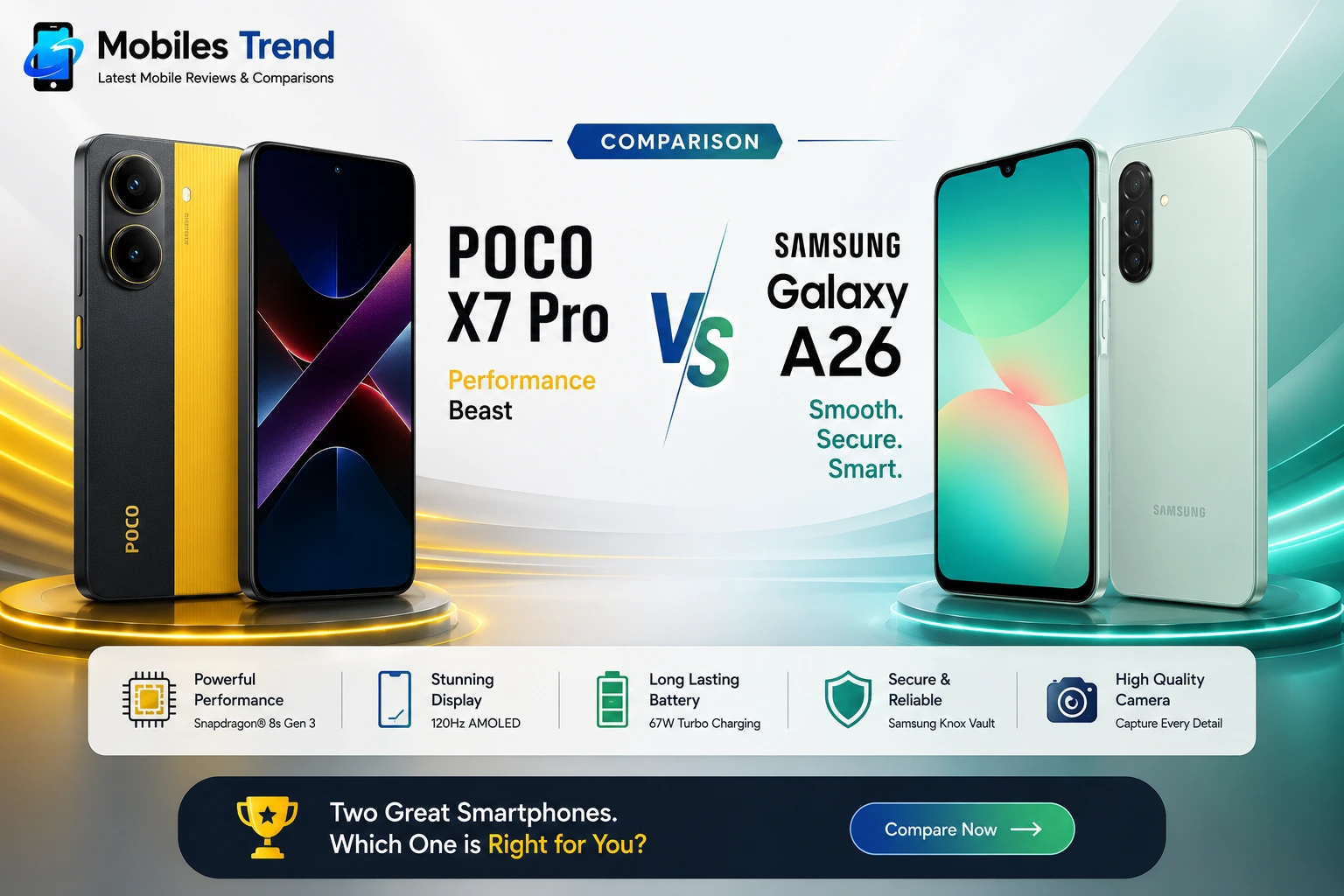
Pakistan’s smartphone market in 2026 is producing buying decisions that would have been genuinely difficult to predict two years ago. The POCO X7 Pro and Samsung Galaxy A26 5G are not phones that would traditionally appear in the same comparison — one is an aggressive performance device from a brand that exists specifically to challenge the value assumptions of established players, and the other is a mid-range offering from the world’s largest smartphone manufacturer with a service network, brand trust, and software commitment that no competing brand in Pakistan currently matches.
But Pakistani buyers are searching for exactly this comparison — and for good reason. The Rs. 15,000 gap between these two phones represents a genuine decision point where every rupee of difference needs to earn its keep. The POCO X7 Pro at Rs. 89,999 brings a Dimensity 8400 Ultra chipset, a 3000 nits AMOLED display with Gorilla Glass Victus 2, 90W charging, and IP68 waterproofing that reads like a specification sheet from a phone that should cost considerably more. The Samsung Galaxy A26 5G at Rs. 74,999 answers with six years of software updates, Samsung’s nationwide service network, IP67 water resistance, a Super AMOLED display with Gorilla Glass 5, and the resale value that Samsung’s brand consistently commands in Pakistan’s used phone market.
This comparison exists to tell you honestly which phone is right for you — not which phone wins a specification sheet comparison, but which one will serve your specific daily life in Pakistan better over the two to four years you will actually own it.
Both phones have been reviewed individually and in depth. You can read the complete POCO X7 Pro review and the complete Samsung Galaxy A26 5G review on our site before reading this comparison if you want full specification context. This article focuses entirely on the direct differences that determine which phone is actually the better purchase for you.
Price — The Rs. 15,000 Question
The Samsung Galaxy A26 5G is officially priced at Rs. 74,999 for the 6GB RAM and 128GB storage base variant in Pakistan. An 8GB RAM and 256GB storage upgrade is available at Rs. 84,999.
The POCO X7 Pro is officially priced at Rs. 89,999 for the 12GB RAM and 256GB storage variant. This is the only configuration available.
The Rs. 15,000 gap between the base variants of these two phones is real money in Pakistan’s economy. Whether those Rs. 15,000 represent genuine value depends entirely on what those Rs. 15,000 buy in terms of daily improvements and that is exactly what this comparison determines section by section.
Comparison at a Glance
| Feature | POCO X7 Pro | Samsung Galaxy A26 5G |
|---|---|---|
| Price | Rs. 89,999 | Rs. 74,999 |
| Chipset | Dimensity 8400 Ultra 4nm | Exynos 1380 5nm |
| RAM | 12GB | 6GB or 8GB |
| Storage | 256GB UFS 4.0 | 128GB or 256GB |
| Memory Card | No | Yes dedicated slot |
| Display | 6.67 inch AMOLED 144Hz | 6.7 inch Super AMOLED 120Hz |
| Peak Brightness | 3000 nits | Standard HBM |
| Display Glass | Gorilla Glass Victus 2 | Gorilla Glass 5 |
| Main Camera | 50MP f/1.6 OIS | 50MP f/1.8 OIS |
| Camera System | Dual 50MP plus 8MP ultrawide | Triple 50MP plus 12MP ultrawide plus 5MP macro |
| Video | 4K at 60fps 240fps slow motion | 4K at 30fps |
| Front Camera | 20MP | 13MP |
| Battery | 5110 mAh | 5000 mAh |
| Charging | 90W wired | 25W wired |
| Water Resistance | IP68 1.5m 30 min | IP67 1m 30 min |
| NFC | Yes | Yes |
| Fingerprint | Side mounted | Under display optical |
| Software Updates | Not specified | 6 major Android upgrades |
| 5G | Yes | Yes |
Display — 3000 Nits vs Super AMOLED
Both phones use AMOLED display technology — but they use it differently and the differences matter in Pakistani daily life in specific ways.
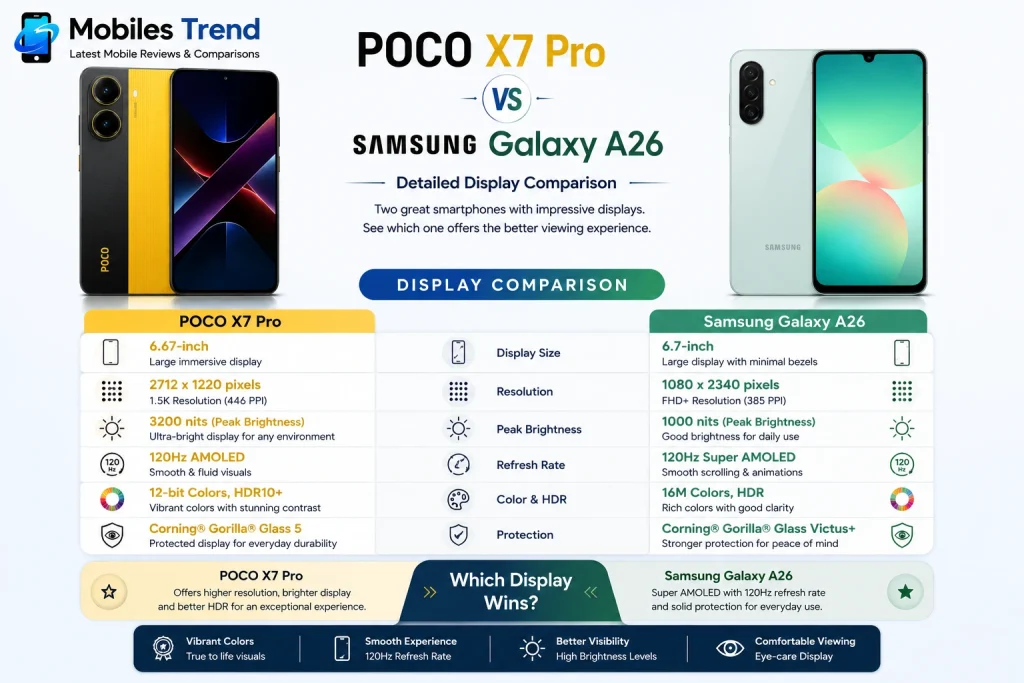
The POCO X7 Pro’s 6.67-inch AMOLED panel hits 3000 nits peak brightness. The Samsung Galaxy A26 5G’s 6.7-inch Super AMOLED hits a lower peak brightness figure that Samsung has not officially specified but falls well below 3000 nits. In practical Pakistani terms, the POCO X7 Pro screen stays fully bright, fully readable, and fully color-accurate under direct Karachi and Lahore summer sunlight in a way that the Galaxy A26 5G cannot consistently match.
The Gorilla Glass Victus 2 on the POCO X7 Pro versus Gorilla Glass 5 on the Galaxy A26 5G is a durability difference that manifests over months of daily use rather than in a single dramatic incident. Gorilla Glass Victus 2 is specifically engineered to survive drops on the rough concrete and asphalt surfaces that are common in Pakistani urban environments. Gorilla Glass 5 provides good everyday scratch resistance but does not match Victus 2 against the kind of face-down drops on rough outdoor surfaces that happen in real daily life.
The 144Hz refresh rate on the POCO X7 Pro versus 120Hz on the Galaxy A26 5G is a difference that casual users will not notice. Competitive gamers who play PUBG Mobile at frame rates above 90fps will notice — but for everyone else, both displays feel smooth and modern in everyday navigation.
The 2160Hz touch sampling rate in gaming mode on the POCO X7 Pro is the display specification that competitive players will care about most. At 2160Hz, the display registers touch commands so quickly that the gap between physical input and in-game response effectively disappears. The Galaxy A26 5G’s standard touch sampling rate is adequate for casual gaming but does not match the POCO’s competitive gaming responsiveness.
Winner: POCO X7 Pro on brightness, glass quality, and gaming display performance. The gap is meaningful in Pakistani outdoor conditions and competitive gaming specifically.
Camera — Triple vs Dual, But It Is More Complicated Than That
This section requires honest framing because the raw camera specifications favor each phone in different shooting scenarios — and understanding which scenarios apply to your daily photography habits determines which camera system actually serves you better.
The Samsung Galaxy A26 5G has three rear cameras — a 50 MP main with OIS, a 12 MP ultrawide, and a 5 MP macro. The POCO X7 Pro has two rear cameras — a 50 MP main with OIS and an 8 MP ultrawide. Samsung has the more versatile camera system on paper, and the 12 MP ultrawide versus 8 MP ultrawide gap means Samsung’s wide-angle shots retain more detail in the edges of the frame.
But the POCO X7 Pro’s main camera has an f/1.6 aperture versus the Galaxy A26 5G’s f/1.8 aperture. This aperture difference is not a minor specification gap — f/1.6 allows approximately 30 percent more light to reach the sensor than f/1.8. In indoor photography, evening events, restaurant lighting, and any scenario where light is limited, the POCO X7 Pro’s main camera consistently produces brighter, cleaner, more detailed results from the same scene. For the typical Pakistani user whose primary camera challenge is indoor and evening photography rather than ultrawide landscape work, the POCO X7 Pro’s wider aperture main camera outperforms the Galaxy A26 5G’s triple system in the shots that matter most daily.
The video comparison is the area where the POCO X7 Pro creates the clearest gap. 4K video at 60fps versus the Galaxy A26 5G’s 4K at 30fps, and 1080p at 240fps slow motion versus the Galaxy A26 5G’s standard slow motion — these are meaningful video quality differences for Pakistani content creators and anyone who shoots event footage, family videos, or social media content regularly. Our best phone for content creation in Pakistan 2026 guide explains why 4K 60fps with OIS makes a visible difference in real-world video output.
The front cameras tell a similarly clear story. The POCO X7 Pro’s 20 MP front camera versus the Galaxy A26 5G’s 13 MP front camera means sharper selfies, more detailed video calls, and better quality face-to-camera content across all social media platforms.
Winner: POCO X7 Pro on main camera aperture, video quality, front camera resolution, and slow motion capability. Samsung Galaxy A26 5G on camera system versatility with the ultrawide and macro addition.
Performance — This Is Not a Close Contest
The performance comparison between the Dimensity 8400 Ultra and the Exynos 1380 is the area of this comparison where the data is clearest and the conclusion is most straightforward.
The Dimensity 8400 Ultra is MediaTek’s near-flagship chipset — the same processor found in the Infinix GT 50 Pro gaming phone and a processor that posts benchmark scores placing it in direct competition with chipsets found in phones costing Rs. 150,000 to Rs. 200,000. The Exynos 1380 is Samsung’s mid-range chipset — a reliable and thermally stable processor that handles everyday tasks and casual gaming competently but operates in a fundamentally different performance tier than the Dimensity 8400 Ultra.
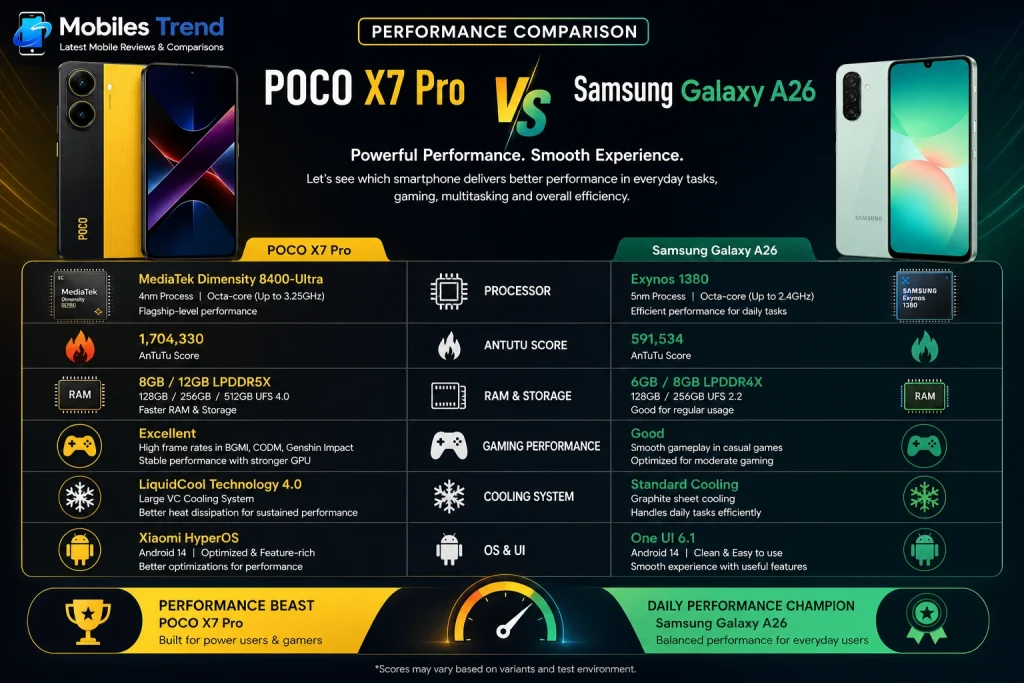
In PUBG Mobile, the POCO X7 Pro runs at HDR graphics with Extreme frame rates for full match durations. The Galaxy A26 5G runs PUBG Mobile at HD graphics with Ultra frame rates. This is a two-tier difference in the highest-demand mobile gaming scenario in Pakistan — and it is a difference that any competitive PUBG player will feel immediately and permanently. Our best gaming phone under 100000 Pakistan 2026 guide ranks the POCO X7 Pro as the strongest gaming option under Rs. 90,000 precisely because of this chipset advantage.
The 12GB RAM in the POCO X7 Pro versus 6GB in the Galaxy A26 5G base variant creates a multitasking experience gap that everyday users — not just gamers — will notice. Switching between WhatsApp, Chrome, YouTube, Instagram, and a game without app reloading happens smoothly on 12GB RAM. On 6GB RAM, heavier apps begin reloading after sitting in background memory during the same multitasking session. The Galaxy A26 5G’s 8GB upgrade option at Rs. 84,999 narrows this gap but does not close it.
The UFS 4.0 storage in the POCO X7 Pro versus the Galaxy A26 5G’s UFS 2.2 means games load faster, camera shutter lag is lower when shooting to storage, and large file transfers complete more quickly. These are not dramatic differences in everyday use but they compound over months of daily interaction into a consistently snappier experience.
The 90W charging on the POCO X7 Pro versus 25W on the Galaxy A26 5G is the performance-adjacent specification that affects daily life most practically. The POCO X7 Pro charges from zero to full in approximately 42 minutes. The Galaxy A26 5G takes approximately 90 minutes at 25W. In a country where power supply reliability varies and charging windows are not always guaranteed, the POCO X7 Pro’s 90W charging provides a resilience that 25W simply cannot match.
Winner: POCO X7 Pro by a significant margin on chipset performance, RAM, storage speed, and charging speed.
Battery — Similar Capacity, Very Different Daily Experience
Both phones carry approximately 5000 mAh of battery capacity — the POCO X7 Pro at 5110 mAh and the Galaxy A26 5G at 5000 mAh. In terms of endurance under similar use patterns, both phones deliver reliable all-day battery life. Neither phone is a two-day device the way phones with 6000 mAh and above batteries are. Both will need charging once per day under heavy use.
The difference is entirely in what happens when the battery runs low. The POCO X7 Pro’s 90W charging transforms a 20-minute break into a meaningful top-up — going from 15 percent to approximately 65 percent in that time. The Galaxy A26 5G’s 25W charging in the same 20 minutes adds perhaps 20 percent. Over a day with variable access to charging points — the reality of most Pakistani users’ lives — this difference accumulates into a meaningfully different ownership experience.
The IP68 on the POCO X7 Pro versus IP67 on the Galaxy A26 5G means different submersion depth and duration protection, but both ratings provide practical everyday water resistance that covers Pakistan’s monsoon season, accidental spills, and rain exposure with confidence.
Winner: Tie on endurance. POCO X7 Pro on charging speed and water resistance depth.
The Samsung Advantage — What Specifications Cannot Capture
This comparison would be incomplete without addressing the four things Samsung offers that the POCO X7 Pro does not and that specifications sheets do not measure.
Six years of guaranteed software updates starting from Android 15 means the Galaxy A26 5G will receive major Android upgrades until approximately 2031. POCO has not made a comparable commitment for the X7 Pro. For Pakistani buyers who keep their phones for three to five years — which describes a significant portion of Pakistan’s smartphone market — this difference is genuinely meaningful. A phone that receives security patches and major Android upgrades for six years retains its usability and security relevance significantly longer than one that stops receiving updates after two or three years.
Samsung’s authorized service center network in Pakistan is the most extensive of any smartphone brand in the country. In cities like Lahore, Karachi, Islamabad, Faisalabad, Multan, Peshawar, and hundreds of smaller cities and towns across Pakistan, Samsung service centers are accessible, staffed by trained technicians, and carry genuine spare parts. POCO’s service presence is growing but is currently concentrated in major urban centers. For buyers in smaller Pakistani cities or anyone who values repair accessibility, this network difference is a genuine daily-life consideration.
Resale value in Pakistan’s used smartphone market consistently favors Samsung over competing brands. A two-year-old Samsung Galaxy A phone commands a meaningfully higher percentage of its original price than a two-year-old POCO phone with comparable original specifications. For buyers who upgrade their phones regularly, this resale value difference partially offsets the Galaxy A26 5G’s Rs. 15,000 lower purchase price.
The dedicated microSD card slot on the Galaxy A26 5G — absent on the POCO X7 Pro — allows storage expansion without choosing between a SIM slot and a memory card. Pakistani users who carry a second SIM for data while also needing expandable storage will find this practical advantage significant even though specifications-focused buyers often overlook it.
Who Should Buy the POCO X7 Pro
Buy the POCO X7 Pro if gaming performance is a primary daily use case and you want the best chipset available under Rs. 90,000. Buy it if display brightness matters for outdoor use in Pakistani sunlight. Buy it if 90W charging and a phone fully charged in 42 minutes changes your daily rhythm meaningfully. Buy it if you shoot video content and 4K 60fps with OIS versus 4K 30fps is a visible quality difference for your audience. Buy it if you want the strongest display glass available in this segment through Gorilla Glass Victus 2.
Read the complete POCO X7 Pro review for the full picture of everything this phone delivers at Rs. 89,999.
For buyers who want to see how the POCO X7 Pro compares against the strongest alternative in its price range, our Infinix Note 60 Ultra 5G review at Rs. 94,999 covers the phone that most directly competes with the X7 Pro at Rs. 5,000 above it.
Who Should Buy the Samsung Galaxy A26 5G
Buy the Galaxy A26 5G if six years of guaranteed software updates is a purchase priority that matters for your planned ownership duration. Buy it if Samsung’s nationwide service center network provides peace of mind that competing brands cannot match for your location in Pakistan. Buy it if the dedicated microSD card slot and flexible storage expansion is important alongside dual SIM use. Buy it if Samsung’s long-term resale value factors meaningfully into your upgrade planning. Buy it if the triple camera system’s ultrawide and macro lens versatility matches your photography habits more than the POCO’s wider aperture main camera does.
Read the complete Samsung Galaxy A26 5G review before making a final decision. If you want additional context on Samsung’s overall mid-range lineup and where the A26 5G sits among strong alternatives at nearby prices, our best phone under 50000 in Pakistan 2026 guide covers the strongest competing options below the A26 5G’s price point.
For buyers considering a premium step above both of these phones, our Vivo V70 review at Rs. 179,999 shows what Zeiss-tuned cameras and a 144Hz AMOLED display deliver when budget is not a primary constraint.
Final Verdict
The POCO X7 Pro is the better phone on specifications. The Samsung Galaxy A26 5G is the better long-term ownership proposition for specific Pakistani buyers. Understanding which of those two statements applies to your situation is the entire decision.
If you game seriously, shoot video content, use your phone outdoors in Pakistani sunlight regularly, and charge your phone opportunistically throughout the day — the POCO X7 Pro at Rs. 89,999 is worth every rupee of the Rs. 15,000 premium over the Galaxy A26 5G. Its chipset, display brightness, charging speed, and camera aperture all deliver daily improvements that are immediately perceptible and permanently present in every interaction with the phone.
If you keep your phones for four or more years, live outside Pakistan’s major urban centers, value Samsung’s resale value in upgrade planning, need a microSD slot alongside dual SIM, or prioritize long-term software security above raw performance — the Samsung Galaxy A26 5G at Rs. 74,999 earns its price through ownership advantages that do not appear in any specification comparison but show up every year of the phone’s life.
Overall Winner for Performance and Value: POCO X7 Pro
Overall Winner for Long-Term Reliability and Service: Samsung Galaxy A26 5G
For buyers who want the strongest overall package above both of these phones, our Infinix Note 50x 5G review at Rs. 53,999 covers a phone that delivers AMOLED display quality, OIS camera, and 5G connectivity below the price of the Galaxy A26 5G.